

Text by Lindsey Vandal
Images by John Hook
Whether Erica Karawina was crafting a stained glass window for a house of worship or a monumental public mural, she regarded the natural light surrounding her creations as vital as the glass itself. Often called “Hawai‘i’s First Lady of Stained Glass,” Karawina is revered for her transparent tapestries of color defined by illumination, imagination, and a sense of place.
Born in 1904, in Wittenberg, Germany, Karawina frequented art galleries and museums, and marveled at the ornate stained glass windows of early Gothic cathedrals. At age 19 she moved to Boston, Massachusetts, to study art, eschewing formal classrooms for apprenticeships with working artists. Under the influential American stained-glass artist Charles J. Connick, Karawina spent months researching the history of medieval stained glass before working in the centuries-old method of arranging 1/8-inch-thick colored French antique glass fixed with lead cames, the H-shaped strips of malleable metal used to join the individual pieces of colored glass together. In 1933, she collaborated with her mentor on church windows in Denver, Paris, and New York City, including the Great West Rose Window in NYC’s Cathedral of Saint John the Divine, an impressive 10,000-piece circle which Connick described as “a unique adventure in active prismatic color.”
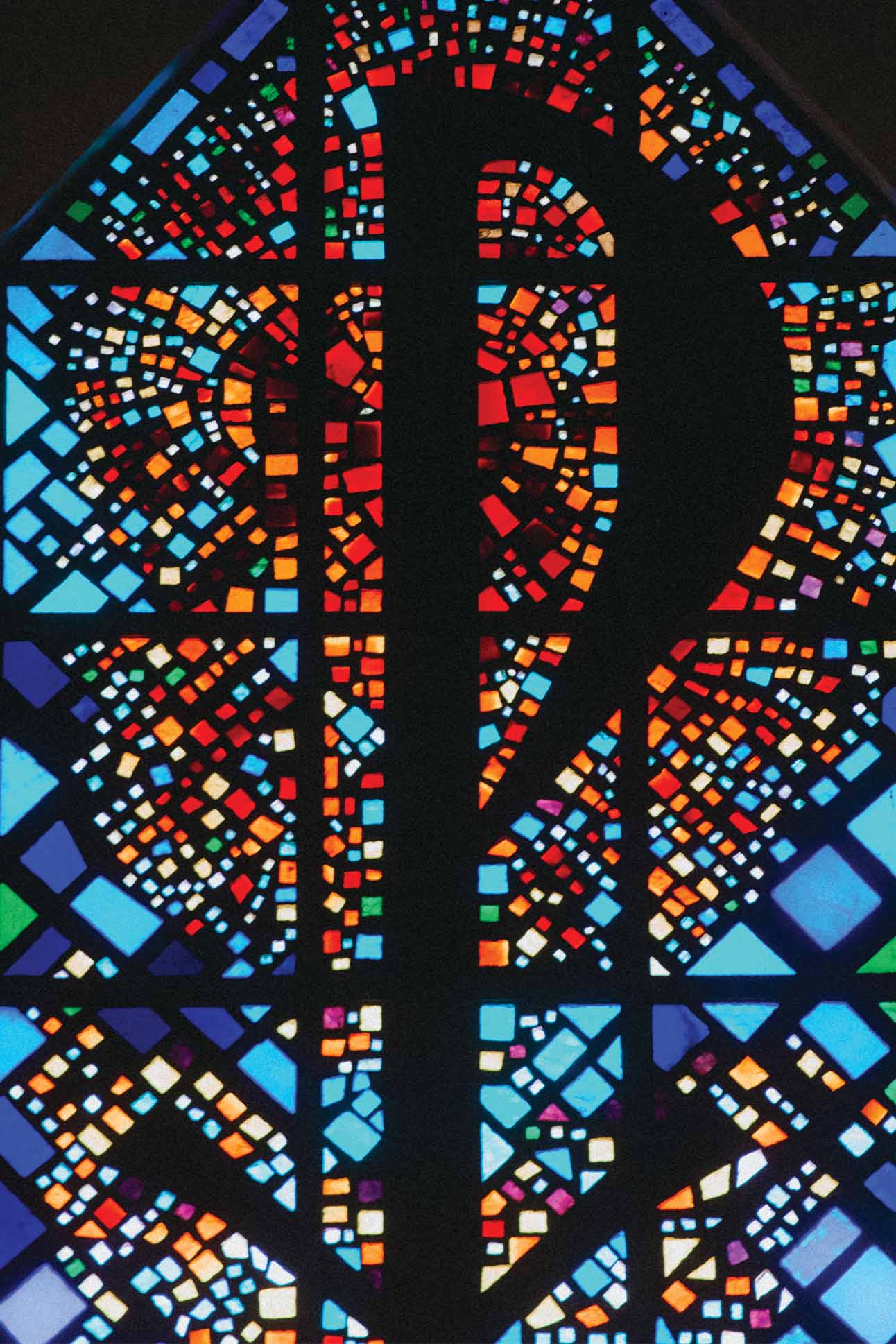
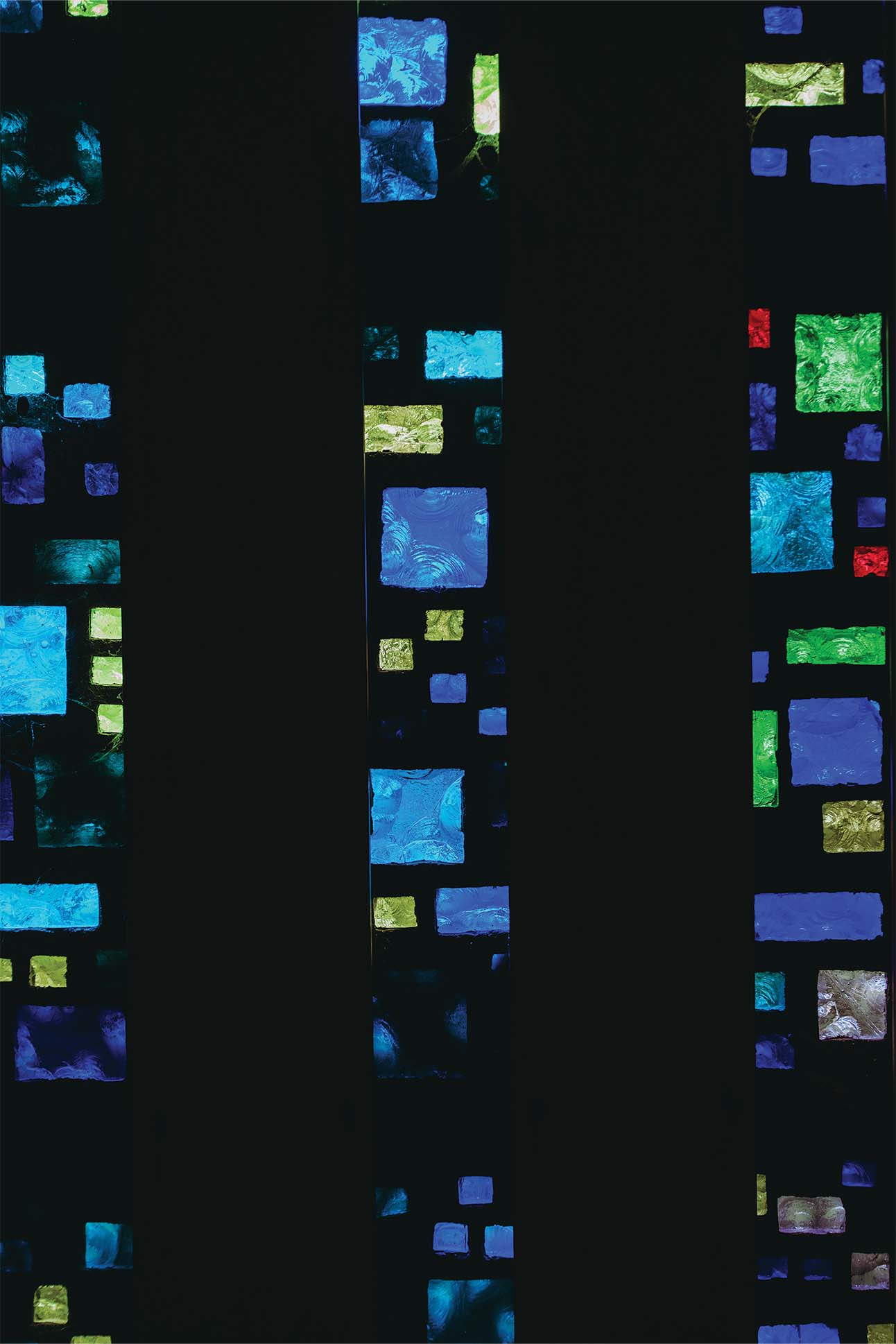
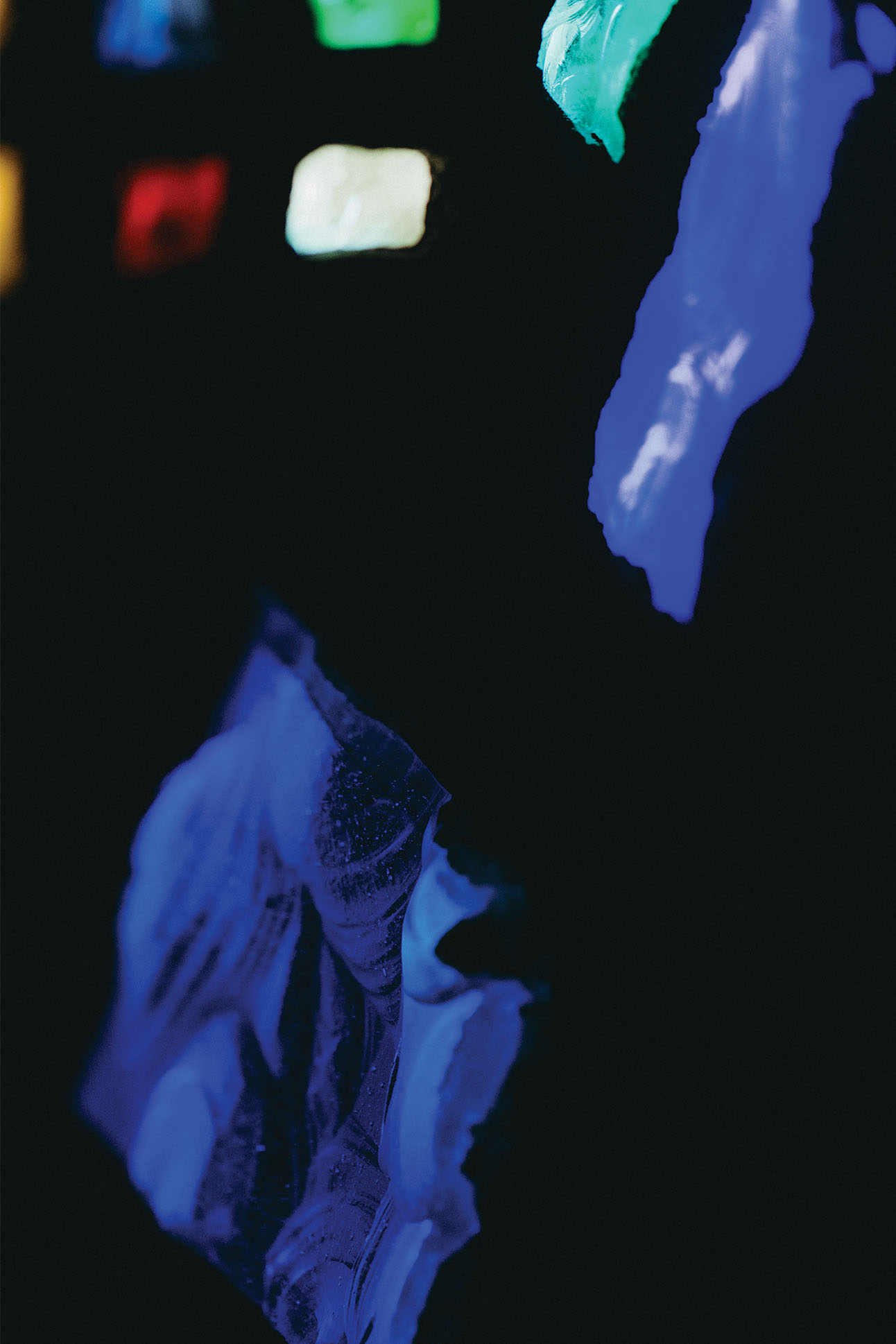
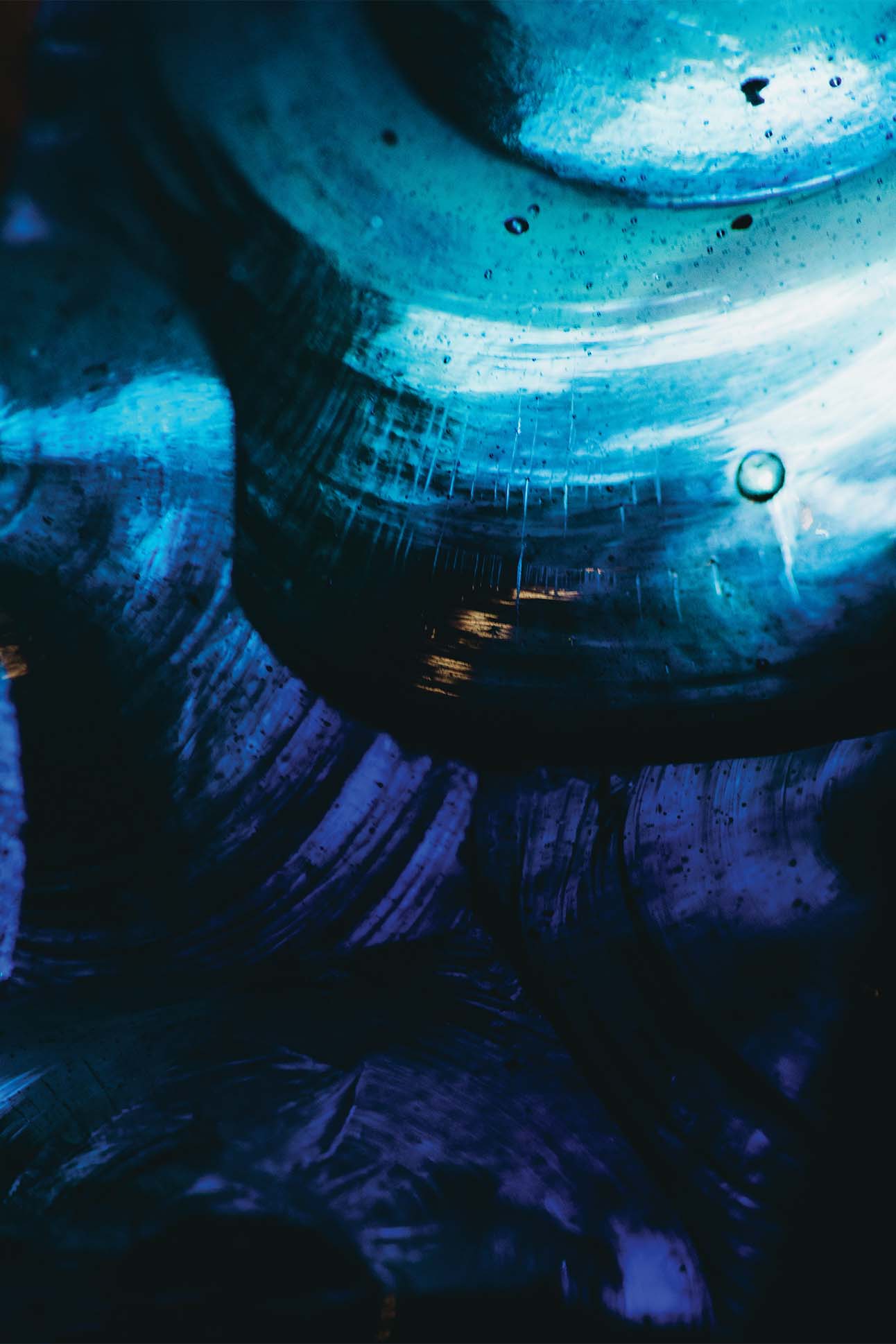
Following an extended stay in China’s Yunnan province, Karawina settled on O‘ahu in 1949, where her husband Dr. Sydney Hsiao joined the zoology department at the University of Hawai‘i at Mānoa. Invigorated by the island’s diverse color palette, she experimented with dalle de verre (slabs of glass), a contemporary stained glass technique in which chunks of colored inch-thick glass (dalles) are hammered by hand to create faceted surfaces, then embedded in a matrix of epoxy or concrete.
The bejeweled qualities of this faceted glass were an extraordinary fit for Hawai‘i’s ample sunlight. “Glass is naturally kinetic, without any gadgets,” Karawina, who balked at the notion of flood lighting, explained in a 1984 episode of the documentary series Artists of Hawaii. “It’s alive.” She worked closely with architects, scrutinizing the natural lighting of a space before sketching out a design, cutting all her glass by hand, and obsessively designating just the right shade for each component of her multifaceted mosaics.
In 1957, Karawina completed her first Hawai‘i commission in traditional stained glass: six storybook windows for the Children’s Chapel at the Salvation Army Wai‘oli campus in Mānoa. Even renowned artists took notice of the dazzling vignettes; French-born artist Jean Charlot praised her bright, playful panels detailing the story of Noah’s Ark and episodes from Jesus’ life in the local paper as “a richly illumined prayerbook.”
Karawina’s prolific work in O‘ahu’s religious sanctuaries — including 15 Biblical windows at Lili‘uokalani Protestant Church in Hale‘iwa, and the towering Chi (X) Ro (P) monogram of Christ at Mānoa Valley Church — set a tone of cheerful reverence and often wove in elements of Hawaiian mythology and culture. In her series for Epiphany Episcopal Church in Kaimukī, an archangel is depicted wearing a malo and Baby Jesus lies swaddled inside a kapa-patterned blanket.
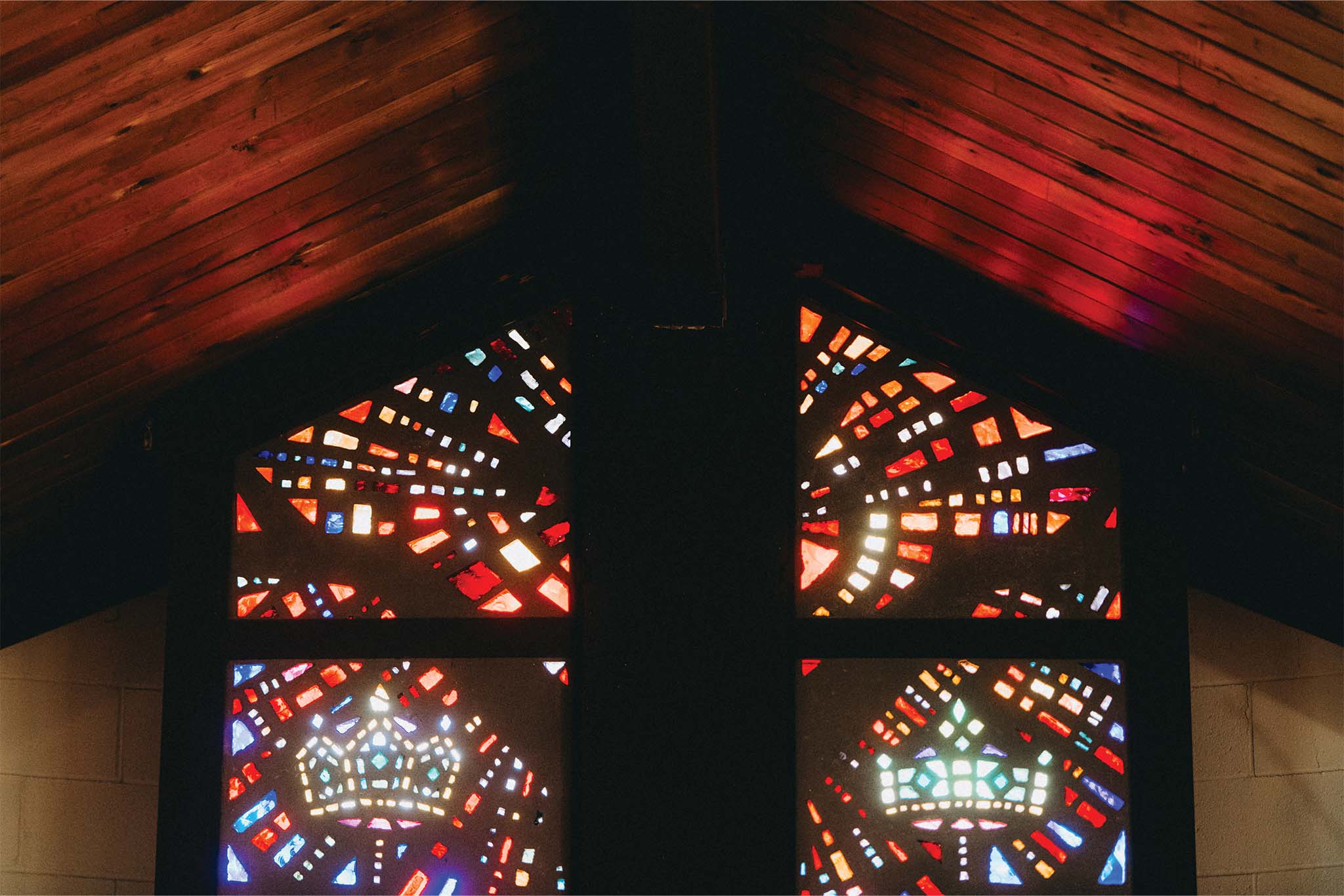
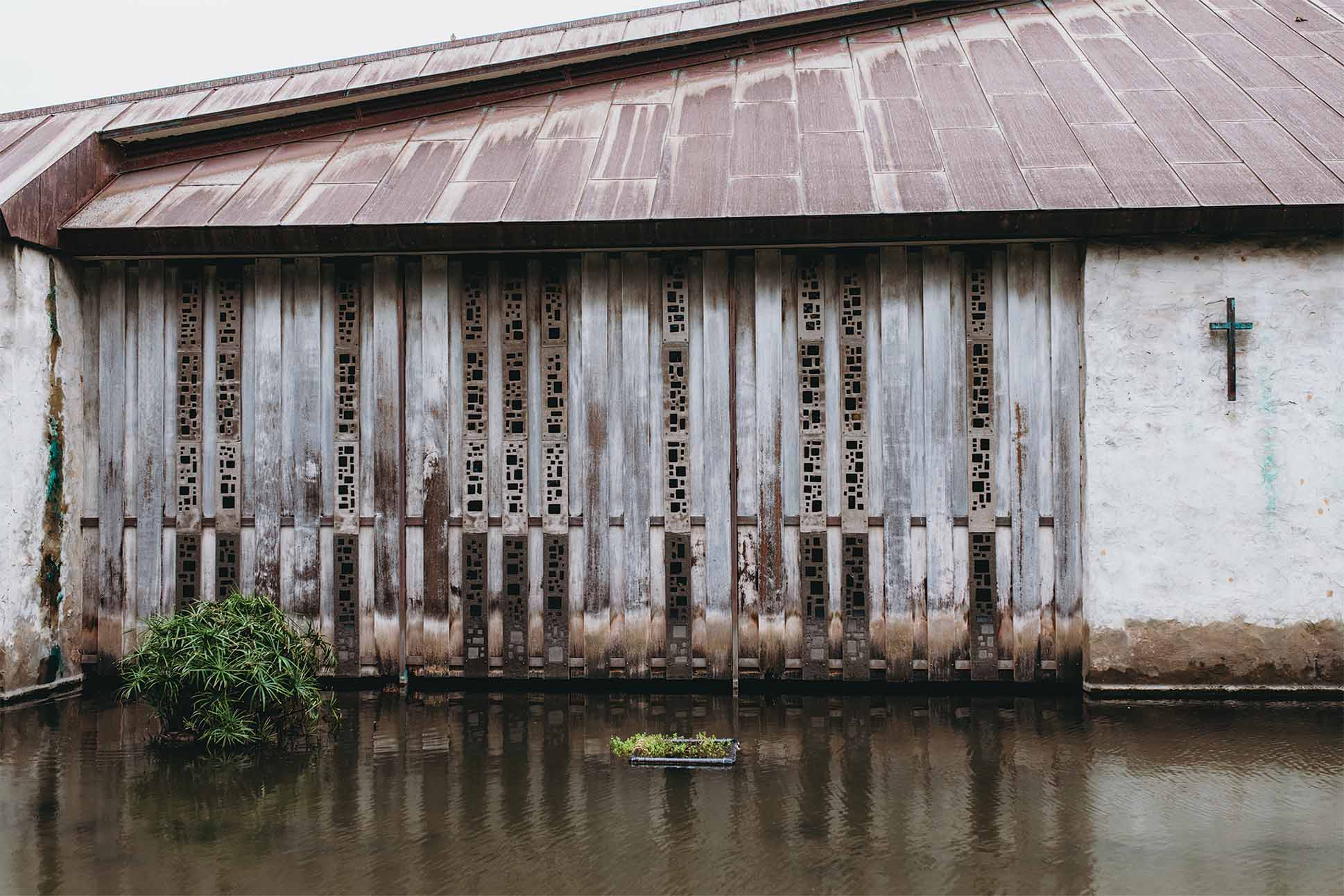
In Punahou School’s Thurston Memorial Chapel, designed by Vladimir Ossipoff in 1966, Karawina’s abstract vertical-stripe windows feature jostling squares and rectangles that refract a spectrum of rainbow colors as they graduate around the altar. “The work functions as both art and teacher,” observes Joshua Hayashi, the lead chaplain. “It introduces fundamental ideas: color as temperature, light as energy, the rotation of the earth. The chapel itself becomes a living instrument, a quiet curriculum that unfolds in light.”
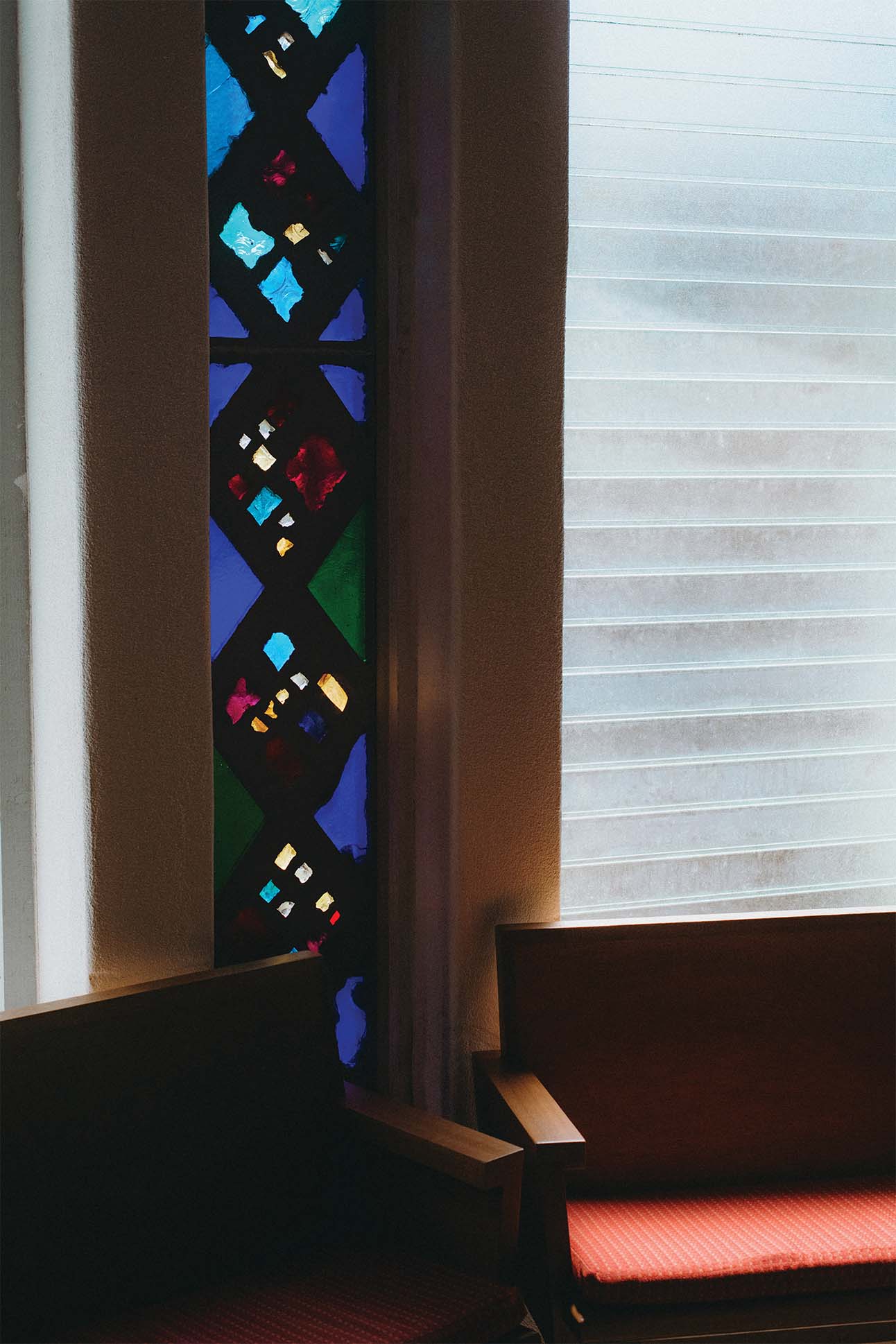
Through two larger-than-life designs in downtown Honolulu, commissioned by the Hawai‘i State Foundation on Culture and the Arts, Karawina proved her skill in coordinating complex stained glass projects and hand-delivered dalle de verre to a broader audience.
In her 1976 installation for Kalanimoku Hale, four top-floor corner murals spanning 2,200 square feet feature Hawaiian gods alongside rainbows, petroglyphs, mountains, and other emblems of Hawai‘i—all aligned with the sun’s trajectory. On the east-facing corners, Kakahiaka and Awakea welcome the warming hours after sunrise; on the building’s west side, ‘Auinalā and Pō salute the gradual dimming of the day.
Entitled Kapa Lele O Hawai‘i, Karawina’s stunning skylight above the central atrium in Ka‘ahumanu Hale unites sixty geometric-patterned panels in a 960-square-foot Hawaiian quilt. Installed in 1983, the piece honors kapa-making, where wauke bark is pounded and tinted with natural dyes to make cloth, as well as the local flora from which the dyes were traditionally sourced.
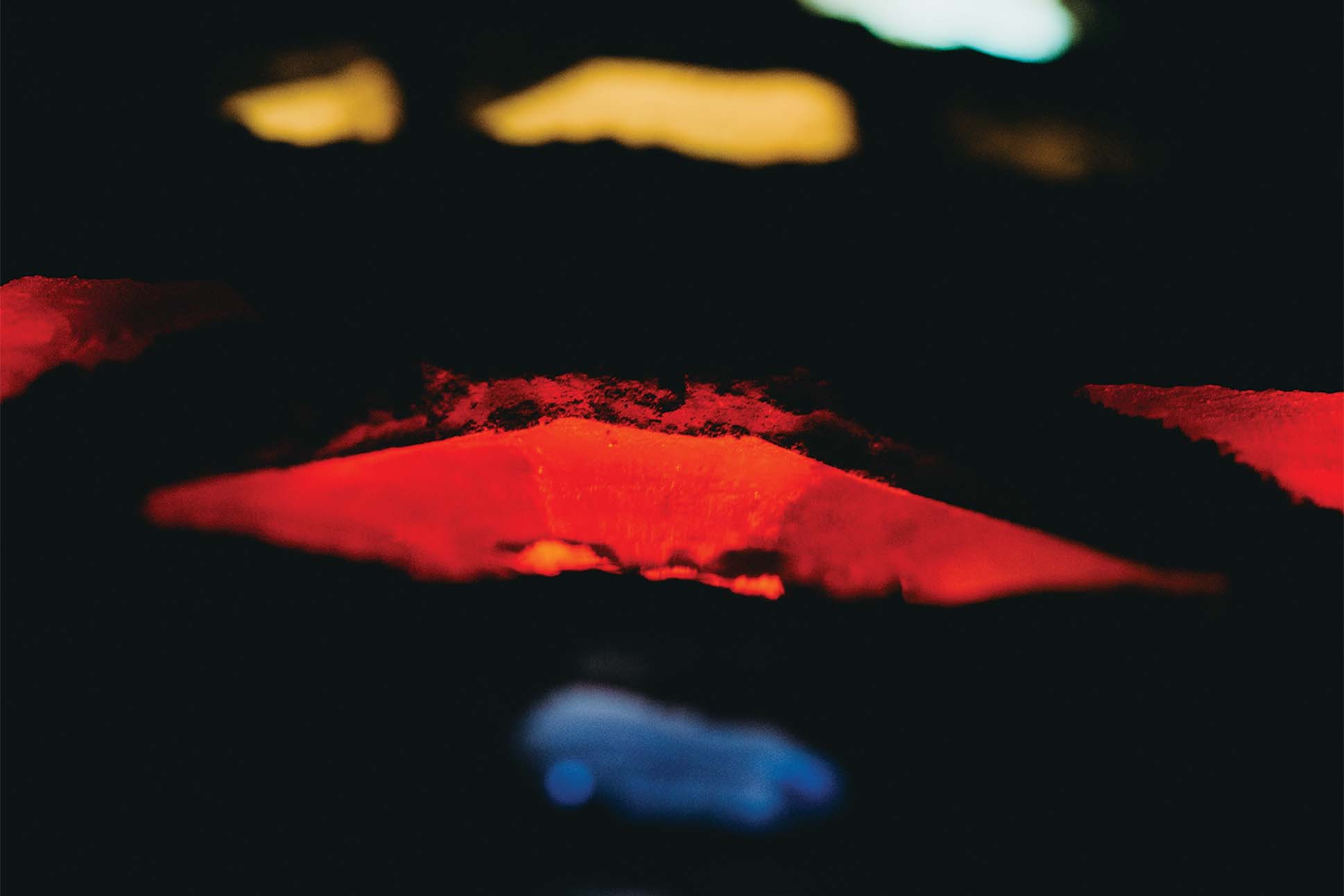
During her life, Karawina also created many freestanding, portable dalle de verre compositions that allowed her complete artistic freedom. In works such as the 15-by-15-inch tilted square, Our Paradise from Which We Are Exited by Some Cosmic Misadventure, and the suspended disc-shaped Black Sun, currently on display inside the Kaimukī Library, she explores themes of divinity, nature, and the metaphysical with a more personal, unfettered flair.
In 2003, Karawina passed away at the age of 99. Her luminous stained glass endures in Hawai‘i’s schools, churches, retirement homes, and libraries, not simply as visual statements, but as invitations to see the everyday spaces we inhabit in a new light. She likened creative work to religion, and found avid joy in sharing her brand of enlightenment with local eyes, telling the Honolulu Star-Bulletin, “Once you have seen pure color come to life, you are never satisfied with anything else.”